
Terrazzo Sealing
Long-term protection of the surface against water, dirt and damage

Terrazzo is a strong, durable and beautiful material. But like any natural, porous surface it needs the right protection if it is to stay functional and look its best for many years. Without it, the surface can become soiled and dull, soak up moisture or even suffer structural damage over time.
Terrazzo sealing is a key step in caring for this material – it protects the surface against water, grease, chemicals and mechanical wear. Whether it is a floor, a staircase, a window sill or cladding, quality sealing significantly extends service life and reduces maintenance costs.
What is terrazzo sealing and why does it matter so much?
Terrazzo sealing means applying a special product into the structure of the terrazzo surface. It forms an invisible protective barrier that:
- prevents liquids, grease and dirt from penetrating,
- protects against frost and salt (important outdoors),
- reduces wear and the appearance of stains,
- makes subsequent cleaning easier,
- prevents mold and moss from forming,
- preserves the color and structure of the material.
Unlike a coating, a sealer does not close the surface off completely – the terrazzo stays “breathable”. Moisture is therefore carried away naturally, which prevents staining, blistering and further deterioration.
When is it time to seal terrazzo?
We always recommend sealing:
- after terrazzo has been restored, ground or polished,
- on newly laid terrazzo floors or stairs,
- at the first maintenance after a renovation,
- in heavily used areas – hallways, entrances, stairwells, schools, hospitals, government offices,
- on outdoor terrazzo – stairs, plinths, window sills, terraces,
- wherever the surface is prone to moisture, grease or chemicals.
Without sealing, terrazzo will eventually become soiled and dull and lose both its looks and its protective qualities.
How do you know your terrazzo needs sealing?
Consider sealing your terrazzo if:
- the floor looks tired, gets dirty quickly and stains stay on it,
- water sits on the surface and soaks in after rain or mopping,
- the tiles or stairs are slippery,
- you want to keep the result of a restoration for as long as possible,
- the surface is unprotected and repeatedly exposed to water, salt or chemicals.
A sealer can be matte (invisible) or color-enhancing. Either way it significantly extends service life and visual quality.
Where is terrazzo sealing used most often?
Sealing terrazzo surfaces makes sense anywhere the material needs greater resistance to moisture, dirt and mechanical wear. Thanks to modern products, sealing can be applied indoors and out.
- Terrazzo floors in apartments, houses and HOA buildings – protection against stains from everyday use, easier maintenance and a lasting shine
- Entrance halls, hallways, stairwells – greater resistance to heavy loads and constant contact with footwear
- Schools, hospitals, office and commercial buildings – hygienic surface protection and a lower risk of dirt and chemicals soaking in
- Historic buildings, heritage-listed interiors – gentle sealing that preserves the original appearance, suitable for sensitive materials
- Outdoor stairs, landings, plinths, terraces – protection against the weather, frost and rain, and a lower risk of cracking
- Window sills, curbs, cladding – preventing water ingress and efflorescence, extending the service life of these features
- Transitions between indoors and outdoors – greater durability in areas with frequent swings in moisture and temperature, and protection against soiling
For outdoor use we apply special sealers that resist UV radiation, water, frost and de-icing salt.
How does professional terrazzo sealing work?
1. Assessing the surface
We establish the condition of the terrazzo, how porous it is, how soiled it is, whether any previous sealer is still active, and which type is most suitable.
2. Thorough cleaning of the surface
Terrazzo has to be cleaned thoroughly before sealing. We remove dust, grease, limescale and chemical or wax residue.
Where the surface is badly damaged, we recommend grinding the terrazzo first to restore its structure and prepare the substrate for sealing.
3. Applying the sealer
We apply the sealer with a brush, roller, mop or sprayer (depending on the type of area). The product soaks in deeply and forms an invisible protective layer within a few hours.
4. Polishing or fixing
Once the sealer has soaked in, the surface can be polished or conserved so that the effect lasts as long as possible.
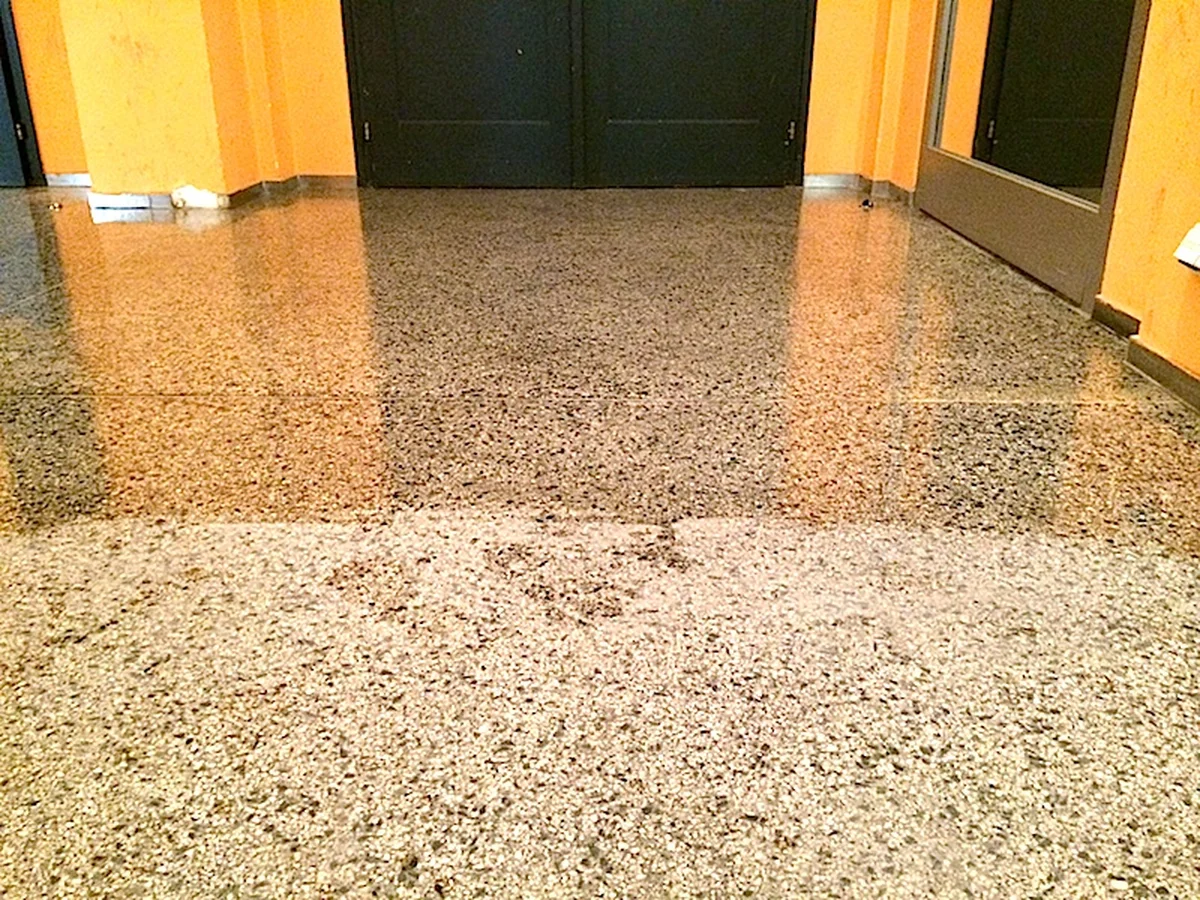
Which sealers do we use?
We use professional sealers made specifically for terrazzo – branded products with a proven formulation. We offer:
- water-based sealers – environmentally friendly, odorless, suitable for interiors,
- silicone and silane sealers – long-term protection for exteriors,
- sealers with a “wet look” effect – they accentuate the color and structure,
- invisible sealers – they keep the original matte appearance.
We always choose the ideal option based on the type of terrazzo, how heavily it is used and where it is (indoors / outdoors).
The benefits of terrazzo sealing
- Protection against water, grease and soiling
- Prevention of staining and material deterioration
- Preservation of the color and structure of the terrazzo
- Reduced slipperiness (with special sealers)
- Easier cleaning and a surface that stays cleaner for longer
- A significantly longer life for the restoration
- A choice of looks – matte, natural shine, color enhancement
Why choose us?
- We use professional, proven sealers only
- We combine sealing with expert cleaning and grinding
- We match the method to the type and age of the terrazzo
- We work throughout the Czech Republic
- We offer fast scheduling and fair prices
- We guarantee the result – contractually and through experience
Frequently asked questions
Why is it a good idea to seal terrazzo?
A sealer protects the surface against water, grease and dirt soaking in. That significantly extends the life of the floor, increases its resistance to staining and makes maintenance easier.
How often does a sealer need renewing?
The interval depends on how heavily the floor is used. In homes, once every 2–3 years is usually enough; in public or commercial spaces with heavy foot traffic it is best to renew it more often – as a rule once a year.
Does sealing change the look of terrazzo?
No. Modern sealers are transparent and change neither the color nor the structure of the surface. If anything, they accentuate the natural shine and give the floor a fresh, clean look.
Is sealing safe for historic and heritage-listed properties?
Yes. We use special, gentle products that respect the original character of the material. The sealer protects the floor without compromising its authentic appearance or value.
Restore your surface to perfection 🤩
Free initial consultation and a quote within 24 hours 🚀
We handle the restoration, grinding, cleaning and sealing of your floors and terrazzo with an emphasis on quality, detail and long service life.